
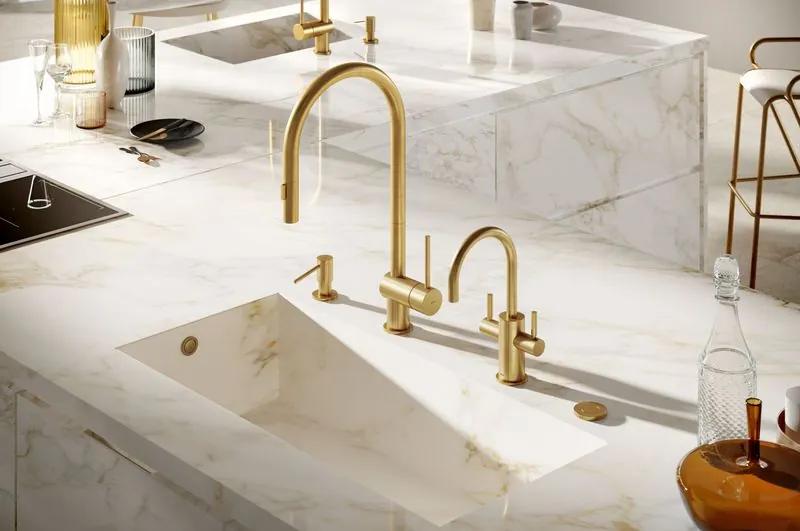
The Shift Away from Stark Minimalism
Data from the National Kitchen & Bath Association (NKBA) and major architectural design firms indicates a definitive shift in countertop aesthetics for 2026. The era of the sterile, all-white kitchen with monolithic, un-veined white quartz is ending. Homeowners are increasingly seeking materials that bring warmth, texture, and organic drama into their spaces.
Trend 1: Warm Undertones and "Greige"
Cool grays and stark whites are being replaced by warmer, earthy tones. Quartz manufacturers are formulating slabs with creamy, beige, taupe, and even subtle terracotta undertones. These warmer palettes pair beautifully with the resurgence of natural wood cabinetry (like rift-sawn white oak and walnut) that dominates contemporary kitchen design.
Trend 2: Dramatic, Oversized Veining (Calacatta Variations)
Thanks to advancements in robotic resin-injection technology during the Bretonstone process, manufacturers can now replicate the massive, dramatic veining of rare Calacatta marbles with astonishing realism. In 2026, we are seeing a preference for thick, contrasting veins (e.g., gold or charcoal veins on a warm white background) rather than subtle, speckled patterns.
Trend 3: Honed, Leathered, and Suede Finishes
The high-gloss polish has been the standard for decades. However, tactile surfaces are the new luxury. Honed (matte) and Leathered (subtly textured) finishes reduce glare from under-cabinet lighting and provide a more organic, natural-stone feel to the touch. Note that matte finishes require slightly more diligent cleaning, as oils from fingertips are more visible than on highly polished surfaces.
Trend 4: The Full-Height Slab Backsplash
Traditional tile backsplashes are being eschewed in favor of seamless design. Continuing the quartz countertop material vertically up the wall to the upper cabinets—or even to the ceiling behind a range hood—creates a striking focal point. This trend is particularly powerful when the dramatic veining is "book-matched" (mirrored) across the seam where the counter meets the wall.
Trend 5: Thicker Edges via Lamination
While European designs favor ultra-thin 1.2cm or 2cm profiles, the American luxury market is trending towards massive, monumental islands. Fabricators are using mitered drop-edges to make a standard 2cm or 3cm slab appear 3 inches to 4 inches thick, creating an anchor piece that feels incredibly substantial.